For this task, I will show research on my blog, of the equipment needed to operate as a live sound technician. I will show the equipment that would be needed in order to set up for a 4 piece rock band with a set up of:
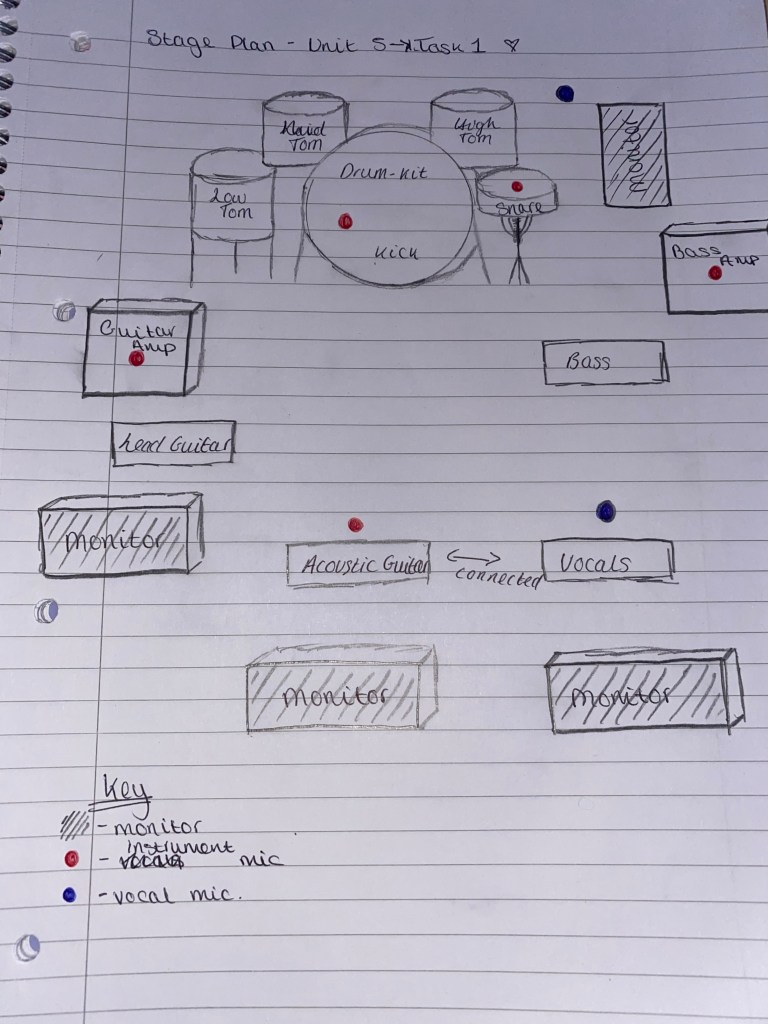
Drums, Guitar x2, Bass and 2 vocals (one for the frontman and one for the drummer.) I will show the microphones used for each instruments and why I would use the microphones. I will then include a stage plan of my set up.
The microphones I would use for each instrument are:
Drums – An Audix D6 for the bass drum, because it is great at capturing low frequencies and keeps the roundness of the low end without distorting the sound. It’s also the mic you’d use for live sound and has a cardioid polar pattern, whereas in the studio, you would use a PG52. For the snare, I would use an SM57 because of it’s high sound-pressure levels and very solid build quality. I could also choose to use SHURE PG81s as overheads so I am able to capture the cymbals because they are very sensitive and pick up a wide range of frequencies. They are great for gaining maximum sound. If I wanted to capture the toms, which is quite unlikely most of the time, I would use a Senheiser E604 as it can handle a wide range of frequencies and dynamics. This mic has a hun compensating coil and has low sensitivity which is able to handle noise.
Guitar – For the guitar, the mics are usually plugged into a stack/combo amp as they’re able to control everything but if you wanted to capture an amplified guitar using a mic too, you can choose a Senheiser E906. It features a switchable presence filter and has a super-cardioid polar pattern. It has a crisp and snappy sound. For an acoustic guitar, you would use a RODE NT1000 as it’s a condenser microphone which means it’s very sensitive and able to pick up even the smallest sounds from the strings.
Bass – For a bass guitar, you would use an AKG D112 on the bass amp because it can handle high sound pressure levels and a large amount of vibration. It gives the bass a crunchy, deep feel and is able to produce a great sound without distorting which is very important and a good reason to use this microphone. It has cardioid polar pattern.
Vocals – For singer and drummer, you will use the SM58 as it is a very good quality mic. It handles your voice with clarity and leaves any background noise behind. The mic helps deliver a warm, crisp sound every time. If there was no SM58, you could resort to the 57, however it is only really used for high sound pressure levels. For the drummer, it will have to be positioned carefully as it needs to be in a place where the drummer can move to sing into it, whilst also having to play but so it doesn’t get in the way of them. This can be sorted put beforehand. For the singer, they can just use a mic stand at the front.
Stage Plan:
 Fran Adams Drums