UNIT 3 TASK 1

For Task 1 Unit 3, I will be discussing 3 job roles that I am interested in and how to potentially get into it. Also, I will be talking about the potential earnings of the job roles and the career path it will lead into.

3 areas of work I am interested in:

Session Musician – a freelance musician that is hired to play on recording sessions or in live performances. They are not permanent members of a band/music ensemble.

To become one, or at least a successful one, you need to be a professional at your instrument. You need to be talented, and able to play pretty much anything as you never know what you are going to be asked to do. Improvisation is a necessary skill within this job as you need to be able to offer your skills into any musical arrangement. To also help, a good network of relationships with other people in the music industry is good as it can get your name out there more and therefore give you more business and promotion.

The potential earnings for the job, completely depends on how skilled you are at the craft. If you’re considered highly professional and talented, you’ll constantly be needed by recording studios and artists/bands at live performances. However, if you ae known to be unprofessional and not very talented, you won’t ever get any business, unless they need someone cheap just to do the job. You could be earning between £100-£2,500 a max on a job, or you could be earning £10,000+ if you’re talented and people like you. Some people can even earn into the six digits if they are really talented. It all depends on the commitment and the effort you put in, however this doesn’t just happen. You have to build up a business, and it can take a while. Building up enough clients to earn a living is a lot of hard work and it doesn’t just happen in a day. It will take months, if not years. A session musician is a long term job so you have to commit to it.

Some famous session drummers are Kenny Aronoff, who has played with Avril Lavigne and played at The NFL, plus many more. Karl Brazil who has been able to play with Robbie Williams, Elton John, Girls Aloud and Take That. But the most famous is Ash Soan who has played with the famous Adele, Cee Lo Green, Natasha Bedingfield, Alesha Dixon and Boyzone.

The way to become a session musician is by completely putting yourself out there. Networking is key, it’s all about who you know and this can help you gain potential clients. Another way of gaining business is through promoting yourself over social media. Use advertisement so people can see your work. It also helps if you create a portfolio, it can give them a sample of your work and then a good idea on what you can bring to the table. Another key way to becoming a session musician is doing constant practice, you need to improve your performance skills so you are always excelling at what you do, making you more desirable. You start this business by yourself and the amount of success is all down to how much effort you put in. You have to commit and it’s important to remember that the money won’t just fall into your hands, you have to work for it by promoting yourself and working hard to do your job well.

For my career potential assessment, I know that I would not be ready for this as I definitely don’t have the networking skills yet and I don’t have a very big online presence, however I am working on this at the moment and I am trying to build a portfolio of myself online via YouTube and I have posted some of my performances that I carried out at college during the performance workshop. However to get business, I need to be a lot more skilled at my instrument which I am not yet, but again I am still improving on that with weekly lessons from a teacher still, and daily practice on the kit.

Music Teacher – someone who teaches you how to play an instrument. I will looking at how to become a drum teacher. This can be done in your own home, a space where you can teach (as a private instructor) or at a school. I will be discussing how to become a private music tutor as that is what I am more interested in.

As a private tutor, you will be self-employed so you are in charge of everything. To become one you technically don’t have to have any grades or qualifications, however that obviously would look awful and you would get no business. The more qualifications you have, the better it looks. For example, passing a music course at college would be perfect. You could also use teaching certificates. music diplomas or degrees. It all helps towards your ‘look’ and how people will see you. The better the experience and background of music, the more likely you will look trustworthy, therefore gaining a sufficient amount of clients. Safeguarding certificates are very important to have as you are most likely going to be teaching children between the age of 5 and 16. You should take the DBS certificate to prove you have no criminal offences and are able to work with children. A professional website or some sort of social media to promote your teaching can help you gain clients quite easily too as it can be used to show a portfolio of your skills or past performances.

The potential earnings for a drum teacher all depend on what you raise your prices to. For example, my drum teacher charges £15 for 30 minutes or £30 for an hour. I have a 30 minutes lesson every week so he gains £60 a month from me and has the potential to earn £780 from him in a year if I was to attend every week of the year. If I was to do this, and have around 20 clients doing 1x 30 minute lessons a week, and 15 clients doing 1 hour sessions a week, I would be earning a maximum of £39,000 a year, which is pretty amazing. But again, like the session musician, it will take a lot of effort and commitment to build this kind of business up. It is a long process and a long term job.

Two famous drum teaching companies who help students learn grades are Trinity College London and Rockschool. Drum teachers usually choose one of these exam boards to help there students learn grades if that is what they want to do. It involves learning a certain amount of songs and then ending in an exam so you can go onto the next grade. It is a very helpful guide to becoming a good drummer and most drummers use this for their students. But it also involves the teacher learning all the possible songs tat the student will get to learn. They will need a good understanding of reading the drum notation and also how to play it so the students are able to be taught to a good standard.

I have already discussed the basics in how to start being a private drum tutor. The way to get into it is just by promoting yourself on social media and making sure you detail the prices, what you offer, how the student will get to you and clearly stating how you are going to teach them. Discussions with the parents of the students are highly important as they need to know their child is in safe hands and getting their moneys worth with the lessons. They need their child to be succeeding and benefitting from your teaching.

For my career potential assessment, I could probably teach beginners at the moment, as bringing them up to my level would take at least 4 years and within them 4 years I would also be improving my own skills. I would probably be able to teach myself all the songs from Grades 1-4 within a month. However due to my age and the student having to come to my house where my parents and sister also live, doesn’t give off the best look for parents of the students. I’d also need to manage a lot of my time due to college work, attending college and then also teaching which can be difficult. But if I start getting my name out there now, in 2 years time when I am finished with college, I might be able to start a tutoring business with young kids.

Music Publicist – to spread information about their clients to the public via social media or advertisement.

To become a music publicist, you need to be good at communicating as this is a communications and marketing-based role. It is a key skill to have good people skills so you are able to sell the artist/band you are representing more successfully. There are no qualifications needed as this is once again a self-employing job, and you get hired by musicians or bands. But you need good skills such as networking, because you need to build strong relationships with bands or artists because if you represent them well, not only will they ask you again to promote them, but they will most likely recommend you to others if you do the job well. Your social media game needs to be strong as it has to beat the other promotions going on at the time. You’ll need to try and build a big following, which will take time, so you can become well known around your local area, and also within the music industry. Social media will be a big reason you get most of your business so an Instagram and Facebook account are great examples of where you can start promoting your skills, and then who you represent. I would say that these are the main skills you need. People skills are hugely important too because you need to be able to get along with anyone you work with and maintain a good relationship with clients so you are likely to be asked to work with them again. Good people skills convey how professional you are too.

The potential earnings as a music publicist, again depend on how successful you are at the craft. A publicist works closely with media outlets, marketers and venues. Depending on what you’re promoting and who you are promoting it for, will also depend on how much money you will receive from it. The money can be from £500 – £10,00 a month. On average, a 20+ day of tour publicity can cost around £1500. If you are asked to publish a ‘big story’ for a band or artist, you can be payed around £500. It all depends on what you publish and how big the band/artist is as the bigger the band, the more money you will expect to earn. According to my research, a monthly fee can get you payed between £1000-£2000 if you are a well-known publicist.

Some well known Music PR firms are Organic Music Marketing, who have represented people from Warner Music, Atlantic Records and rappers such as Lil Yachty, Migos and Tyga. Forbes Music Entertainment is another big music publishing company that has represented many celebrities such as Fetty Wap, Black Diamond, Nate $avage and Jim Jones. ‘Forbes’ started in 2014 and is a Hip-Hop promoting company. I think that promoting only one genre can be quite useful as people will come to you, with the understanding that you have more knowledge about the certain genre. For example, Forbes Music Entertainment only represents Hip-Hop artists/groups, so therefore they know who to promote to and their target audiences due to their knowledge of the genre. They will know how to promote it and who to get in touch with. They can also create a good network of clients as the artists that have been represented are likely to suggest you to other bands/artists in the same field.

The way you can start your career as a music publicist is either by starting out on your own and building a following of people so you are able to get jobs and are able to represent people, however the self-employed way can take a while due to starting from scratch. You will need to create a portfolio of what you can do for the potential customer, and then create a good relationship with them using your people skills and professionalism. This can take a long time so the commitment needs to be genuine and you will have to be patient as you won’t gain clients quickly. The other option, is you get hired by a publishing company and work under them instead to guarantee instant business, however you won’t be given anything too major until you have proved you are good at the job. Another negative about this is, although you might develop business much quicker, you may not gain as much money due to working under a company so you are getting paid by them as the client will pay the company, and not you directly.

For my career potential assessment for being a music publicist, I once again wouldn’t be able to carry this out right now, however I would be able to make a start. I could try to build up a big music following on social media, and then get into contact with local bands/artists who have a single/album or some sort of gig coming up in the future and offer my help to promote it. However I need to build on my networking skills and also my social skills so I am able to contact people and have them trust me and build a good relationship with them.

Overall, I have liked learning about these jobs, but the one that intrigues me the most is being a session musician as I will be able to carry on playing my instrument and enjoy it even more throughout my career. It is a long term job which I have accepted and I am definitely willing to put the hard work and commitment in. I want to make my name well-known in the music industry and be able to play with artists I love by having good networking skills and being professional when it comes to doing the job at hand.
UNIT 3 TASK 2

In Unit 3 Task 2, I will be writing a health and safety document which discusses the potential issues that the two areas of work I have chosen may come into contact with. The areas of work I have chosen are being a session musician and a private music teacher (both for drums).

Session Musician:

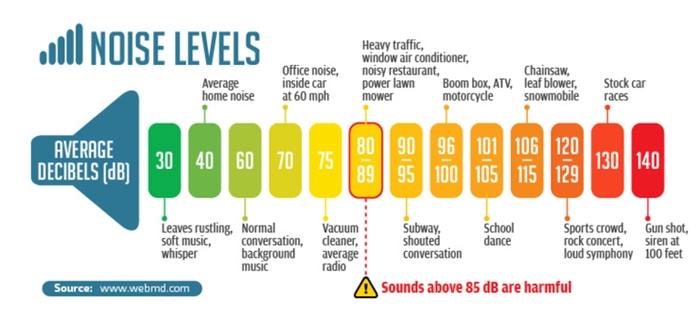
One of the biggest risks when it comes to being a session musician, is the damage that can be done to your ears over the years when playing. Many musicians suffer from Tinnitus, which is a constant ringing or buzzing in the ear that isn’t caused by an outside source. Any noise that is over 85dB must result in you wearing ear protection. When the session musician is playing the drums, they should be wearing ear protection as it is a very loud noise. If it is your job, you are going to be constantly exposed to this level of noise so you need to be careful. According to a source I found, if you listen to loud music for just 20 minutes, you need 1 whole hour of silence to let your ears relax and fix themselves instead of carrying on and just damaging them more. This is why you need ear protection as a session player, as your ears won’t be as exposed due to playing everyday. Here is a graph of how what sort of noises can affect you on the decibel chart:

Levels Of Noise In Decibels (dB) Level Comparison Chart - Sound Proofing  Guide
The chart shows the level of noise that is acceptable to listen to, without ear protection, and what noises you should be more cautious of.

Another risk of being a session musician is the equipment. Drums are difficult to move about, let alone fix and also replace. If you are needed in a recording studio but are asked to bring your own kit because they don’t supply one, you need to be really careful when moving and lifting the heavy parts of the kit. The bass drum can be hard to move around so make sure you always have help if you are unsure when carrying it as you don’t want to risk dropping it and then damaging/breaking it. Also, carrying heavy equipment over the years can cause strain to parts of your body, and it’ll most likely be your back or spine when moving about drum kits. To prevent this, you should only carry parts of the kit that you are able to handle and don’t cause to much strain to your body, if you need help then ask for it as it’s best to have assistance when moving stuff then risking damage to your body and your health. If you injure yourself, it could potentially put you of a job for a long time, if not your whole career.

Music Teacher:

There are a lot more risks in teaching when it comes to carrying it out in a school, but I will be looking at private tutoring.

One of the main risks is the equipment usage. The equipment needs to be safe fore the student to use (they’re most likely young) and you need to make sure they cannot injure themselves on it. Placing the drums in a reasonably easy position for the students to use so they aren’t reaching drums from afar, therefore causing themselves to pull a muscle or strain a part of their body. The drums need to be stable and carefully placed to prevent parts falling or hurting the student. Basically, you just need to be considerate of the fact the child is a lot younger then you and can easily be harmed. You will need to make sure they’re comfortable when playing so you don’t cause them any injury.

Another risk is for the teacher themselves and also the student. Ear protection is vital, but especially for the much younger students as a damaged ear is not what you want to give a student. Playing the drums involves your ears being really exposed to loud noises. Complete drumkits can reach a level of 90-130dB when being played. This obviously depends on how hard you’re hitting the kit and how much you are playing. For example, a rock piece would be on the higher end of that decibel chart as rock is very loud and there are usually a lot of crash cymbals involved and a wide range of frequencies can be heard. But if you were to play a jazz song, it is usually a lot calmer because a ride cymbal is used and the bass drums are quiet. When the teacher is teaching the students grades, they will cover many different genres so a wide range of noise level will happen throughout the tutoring, making it important that the student and teacher wear ear protection. Whether that is ear plugs, or noise cancellation headphones. It is vital that there is some form of protection.

UNIT 3 TASK 3

For Task 3 in this unit, I will be discussing what I’ve leant over the last two terms at college, and how it will benefit me in the industry throughout my career.

When I started the course, I wasn’t really aware with the business side to music, however I did know about royalties due to learning about it in secondary school. What college helped me to understand, was why I needed the royalties and how I was meant to gain them, which is of course very helpful and now I am aware on what money I can gain from certain things. I have also learnt about types of contracts and band agreements. At the moment I am in a band with two friends from college and we have made an agreement that we are all happy with, which entails any rules that we have to stick to whilst being together. On the contract side of things, I knew nothing and I found it interesting to see how many versions of contracts there actually were. I know what to expect in one and also what to look out for in case the contractors are being sneaky in any sort of way. This is because the groups who run contracts are in it for the money, and aren’t interested in the band/artists personal gain so they will try and catch you out to make more money off you.

Within Unit 3, I have learnt a lot about social media presence and how to ‘get your name out there’. Because of this, I now upload (usually weekly with a performance I have done at college on Facebook and my YouTube channel. Although I am not getting many views on YouTube, I am gaining around 100 on Facebook and it is helping put together a good portfolio for anyone who wants to see my skills if they were looking to hire me or ask me for a job. Thanks to college, I have realised the importance of social media presence and how much it can impact your career. For example, I am now in touch with quite a few local bands and have got to know them and the processes they have been through to get gigs and build their audience. This is benefitting me as it is improving my networking skills and will definitely help open up more opportunities for me.

I was also given the chance in Unit 3 Task 1 to explore a variation of job types within the music industry and it gave me an insight to what my future could potentially look like. I looked at teaching/tutoring, being a session player and also becoming a music publicist. These jobs interested me a lot, and being given the task to do research about it really enhanced my views on the possible careers. I was also taught that I would never have a 9-5 job and I am glad I was told that because it has given me a better perspective on what to expect in the years ahead which I found quite helpful. Finding out about these jobs made me appreciate the industry so much more as I understood that it’s not just ‘famous’ musicians who make up the industry and there are so many important behind the scenes jobs that create an impact on the world too.

In Unit 5, I have learnt about stage plans, types of microphones and how instruments really work. We covered many different aspects, including how to set up a stage, drawing stage plans, what microphones suit what instruments, and how to use a sound desk and work with amps and monitors. I enjoyed this a lot and it helped me to understand the set up for gigs, benefitting me as I now know how to set up a bass/guitar amp and many types of microphones. The reason this helped, is because I was originally unaware due to being drummer and only ever having to set that up, but now if I was called in to set up a stage for a 5 piece band, I would definitely be capable of doing it as I now have the knowledge.

The past two terms have helped me improve my skills so much, not just through playing and performing, but also with the business and tech side to the music industry.

UNIT 2 TASK 3

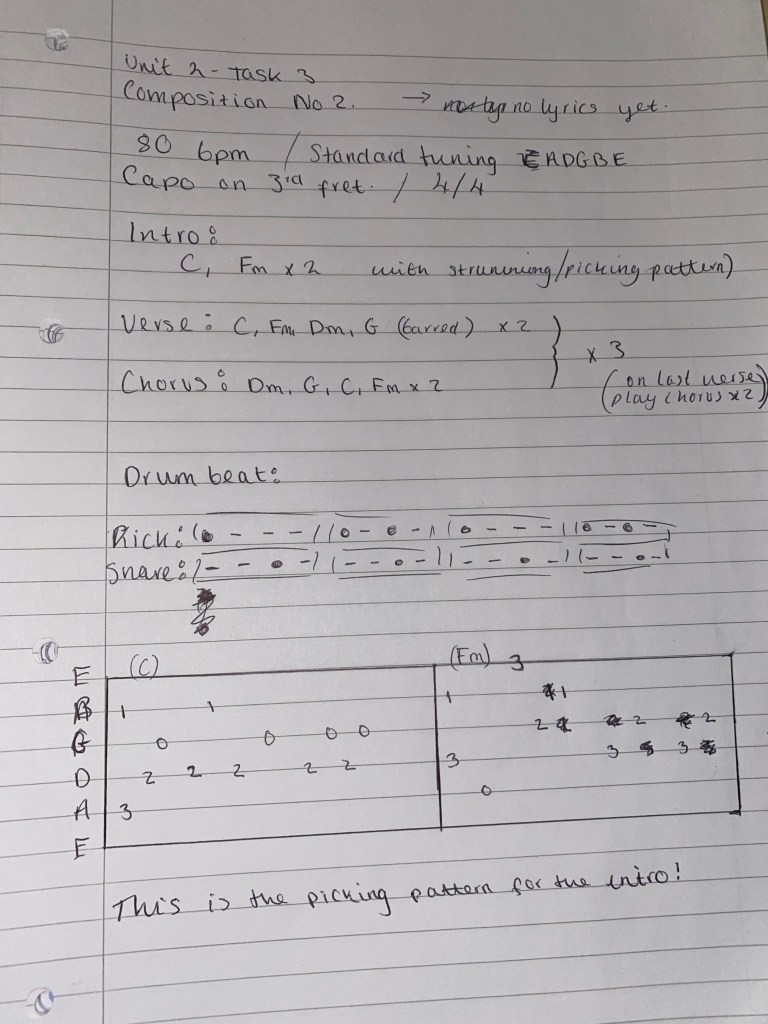
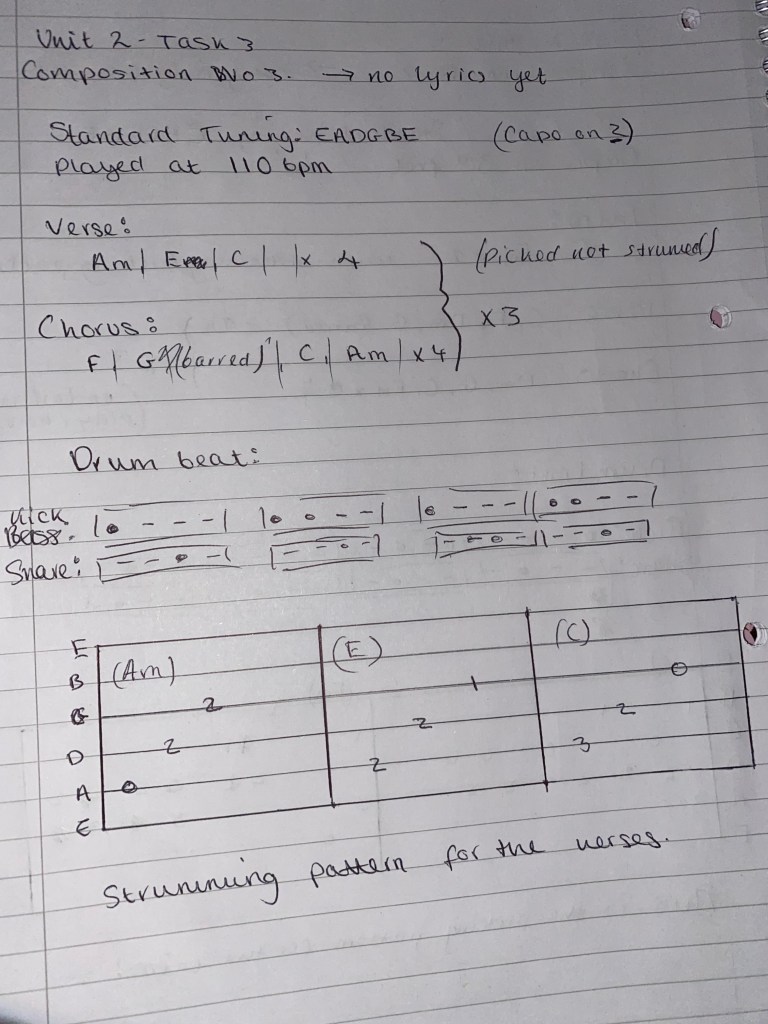
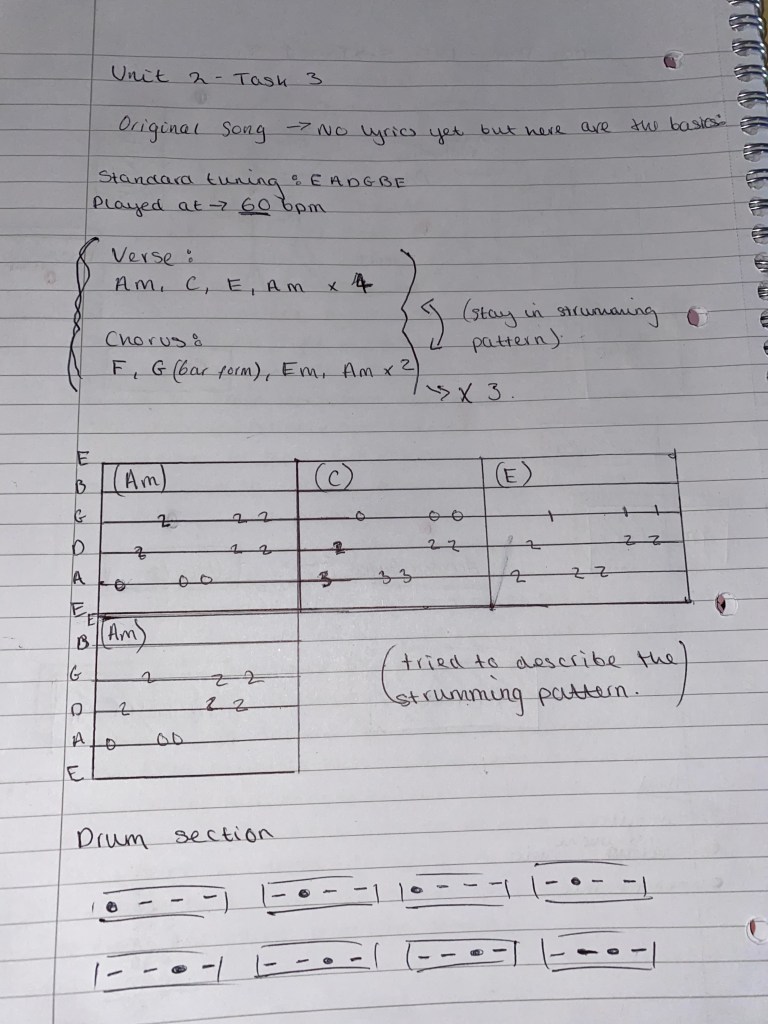
I will be uploading videos and my attempts at a chord/lead sheet as the three compositions I am doing are on guitar. I hope this an acceptable attempt, I tried my best although I am not great with chords or creativity when it comes to guitar.

Composition 1:

Also forgot to label the drum pattern! The first 4 bars is representing the bass drum placement, and the line of bars below is representing the snare. The hi-hat will be constant throughout.

Here is my video of me playing the guitar section of what I wrote above. My skills are not great but I tried my best:

Composition 2:

Here is me attempting to play the intro, verse and chorus:

Composition 3:

Here is a video of me playing the verse and the chorus together:

UNIT 2 TASK 2

ANALYSIS OF A PIECE

In Task 2, I must produce one compositional analysis or a recording or performance of a piece of music. This analysis must include the following.

• Details of the harmony involved expressed in chord names.

• The key centres that are used .

• The Instrumentation.

• The rhythmic details of the individual parts.

For this task, I am going to be analysing the song ‘Ship To Wreck’ by Florence and the Machine which comes under the genre rock, pop. Here it is below:

The song is in the key of A Minor and is played at 140bpm.

A Minor key = A, B, C, D, E ,F ,G

Time Signature: 4/4

There is an intro, two verses, three pre-choruses, three choruses and a bridge, making the song last for three minutes and fifty-five seconds. The instruments involved are piano, vocals, guitar, drums and bass and a glockenspiel.

Guitar and Piano Chords: Tuning for guitar = E A D G B E

Chords involved – Am, F, Dm, C, G

Am chord involves the notes – A, C and E.

F chord involves the notes – F, A and C.

Dm chord involves the notes – D, F and A.

C chord involves the notes – C, E and G.

G chord involves the notes – G, B and D. (A major triad)

STRUCTURE OF SONG:

INTRO: Am, F, Dm, Am (x2)

VERSE 1: Am, F, Dm, Am (x4)

PRE-CHORUS: C, Dm, Am, F (x4)

CHORUS: Am, F, Dm, Am, Am, F, Dm, Am

VERSE 2: Am, F, Dm, Am (x4)

CHORUS: Am, F, Dm, Am, Am, F, Dm, Am

BRIDGE: F, G. Am, F, F, G, Am

CHORUS: Am, F, Dm, Am, Am, F, Dm, Am

For the drums:

This is the only decent cover I could find of the song on YouTube, and I really liked it. It gave off a great energy and i wish I could play like this someday.

The intro starts off with a 16th note groove giving it a dance vibe, making you excited and it always gets everyone in a good mood! It also uses the same groove in the choruses. The verse uses a simple straight groove and it makes it plain, however it suits the song very well. The snare is quite loud in the chorus, and it gives off a nice effect whereas the high-hats are quiet and although the bass drum is there, its not too obvious. I like this, as the kick is used as the rhythm placement so everyone is able to keep in time, and all the instruments play around the beat. The snare sound stands out though, it is loud and can be heard, which reflects well on Florence’s song as her song is quite angry when you think about the lyrics. In the pre-chorus, a ride cymbal is often used to change the song up a bit, however I only found that a few covers used it. In my opinion, the groove sets the mood of the song and I think Florence + The Machine have expressed the mood well.

Overall I love this song, I have enjoyed analysing it and found it interesting. The reason behind choosing it was because it is one of my mums favourite songs and it brings back many a good memory. I had also never looked into this before, or any of this bands songs, and I will now be doing more research into their songs as I like how they are structured and also, the chord progressions that they use.

UNIT 1 TASK 1

I am going to cover 4 techniques over the next four weeks, in hope that it will benefit my improvisational skills, confidence, timing and my sticking pattern (particularly) my left hand. Here is the chart I made that will guide me through it, covering how it went, and if I achieved the goal:

Week No.What will I cover?Did I achieve the task?Do I see an improvement?
1Sticking TechniquesYesYes it has made my left hand lightly stronger and I am better at double strokes and 7 stroke rolls.
2Playing to a clickYesMy timing skills have improved by a lot and I am able to keep to the metronome.
3Improving my left handYesIt has made my left hand stronger. I can also see it improving my confidence when I play fills.
4Improvised fillsYesIt has improved my improvisation skills and I am more confident.

For the first week, one of the improvements I want to make is getting better at sticking patterns. This is because I have always struggled with paradiddles and buzz rolls on the snare drum etc. The reason I want to improve on this is because it holds me back when it comes to fills and improvising. I struggle to play fills that are more complex because I’m unable to make it sound interesting. Therefore panicking and just making it really simple and boring.

The video that I am going to use to improve my sticking pattern, also helps me strengthen my left hand which is an added bonus. This is an audio clip that was suggested to me by my drum teacher:

The video is quite long so I am only going to cover half of it as some of it I haven’t come across yet in any pieces. Because of that, my drum teacher is going to take me through it over the next few lessons that I have with him. It covers 8th notes, double 16ths, 5, 7 and 9 stroke rolls and double strokes.

If I’m honest, I can already see the improvement. I am hoping that if I practice this at least once a day, it will benefit me in the future when coming across fills and interesting sticking patterns in songs.

I will be practicing this twice a day for the next week so I can see an improvement when I am next in my drum lesson and performing fills. This will hopefully benefit me well in the long run so I can become more confident when playing.

This video I am about to show you is me practicing. I cover Rebound 8, 6, 4, and 2, and also doubles in 16th notes, I then cover 5,7 and 9 stroke rolls. I followed along to the video guide, which is what you can hear in the background (also the video I inserted above). There is a metronome that you play along to and that was at a comfortable speed which made it slightly more relaxing. However I did struggle as currently, I don’t have a proper practice pad, I only have a small one which is strapped around your leg. I am hoping to get anew one at some point but for the time being, this is what I will use. Due to the size, I do accidentally miss the pad a few times but it did not affect my rhythm or cause me to mess up. I could definitely improve my 5 stroke rolls at the end of the video as I don’t really get into it straight away, but I end up being less tense and the 7 and 9 stroke rolls start to flow more naturally which is good. As I said above, I will be practicing this at least twice everyday for the next week so I can get used to it.

Here is the video:

The next video you are about to see, is me just playing a simple beat (adding in some small changes every now and again) for 5 minutes. I will be playing it to a metronome set at 110bpm and will try to stay in time for the 5 minutes. The reason I have set it to 5 minutes, is because that is usually longer then most songs, so it gives me more time to practice and concentrate. I predict that I will probably start to lose the timing around the 3 minute mark but I will insist on trying to stay in time. The video I will show below, is the best video I could capture on my phone, however the sound quality is not great.

Here it is:

This task went a lot better then I anticipated, however I did struggle to stay in time around the 4 minute mark, but I was expecting that to happen. The rhythm was slightly lost every now and again, but that is most likely because I have never played a song for that length before. The hi-hat grooves were sometimes lost as I panicked but I managed to get back into the rhythm of it. I will be practicing this twice a day for the next week, and will also be carrying this on in general as I know it will eventually benefit me when it comes to playing gigs and keeping my stamina up. I enjoyed playing in this video as it let me think of so many different variations to add to the groove when I got comfortable with the time. I will be doing this a lot in the future and each time, I am going to increase the speed of the metronome, so I can get comfortable at all speeds. At the end of the video, I felt pleased with the outcome due to assuming I would mess up whilst playing.

The next technique was to make my left hand stronger. This a very important technique to improve for me because a strong left hand, as well as right hand, is key to being a good drummer. It will improve my sticking, fills and genuine playing. It should help play faster grooves and quicker grooves. I plan to follow a video off YouTube and hopefully be able to perform it, however the sound quality of my video is not great as it was shot my phone.

This is the video I found a video online, which gave me the idea of how to work on my left hand:

Here is my version and how I tried to interpret it:

I found this quite difficult as I still need more practice to build up my strength, however I can definitely see a huge improvement when it comes to playing now. There was no metronome to play against as I was using the video as a reference in my earphones. It was all over the place at first but once I got the gist of what to do, it became a lot easier and I was able to do a variety of random fills that involved the right hand too, but always led with the left hand, which is usually what wouldn’t happen for me. This is definitely going to benefit me as I have always began a fill with my right-hand but now I will be able to change that, giving me more options on creating fills, therefore helping me with my next technique too. I will be practicing this everyday at least twice as because I know the result will be good eventually. The video went better then I expected and I look forward to seeing this improve my skills.

My final technique I wanted to improve on was improvising drum fills. I usually find this quite difficult as I am not that confident when being put on the spot, so my fills tend to be rather boring and basic. I chose this video to play along to as I had never heard it before, meaning it was even more improvisational. I chose a ‘funk’ track as I usually don’t play any songs like that, again showing that I am even going to improvise the groove.

This the video I played along to:

This was the outcome: (I listened to the first 30 seconds to picture what the groove could be and how I’d start the intro, but after the 30 second mark, I stopped listening and then hadn’t heard any of it)

I found this technique useful as it has opened up my options to different fills. In this video I got more confident throughout and therefore it caused me to be a little more creative with the fills, however they are still not great. I will be practicing a lot more over the week and will also practice in general as I now it can benefit me in the long run. I messed the groove up a few times because I didn’t know the music obviously, but it did help me gain confidence due to the fact I had nothing to guide me along so I was free to make it up. I think I did a reasonable job of keeping in time, although the beat I decided could’ve been more complex, same goes for the fills I managed to produce. If I keep practicing, I recon this could definitely improve my improvisational skills.

Overall once I get these skills sorted and to a good standard, I will have become a much better drummer and improved so much. The reason I chose all these techniques to work on is because they all join together to make me a more confident person and can improve my improvisational skills more. I will be practicing these techniques constantly as I know it will benefit me a lot.

UNIT 1 TASK 2

These are the three performances I did during workshop before Christmas, and they demonstrate my skills and how they have developed over the term. These performances were all uploaded to Youtube at later dates.

My first performance is a cover of ‘Mardy Bum’ by Arctic Monkeys. I performed with Emma Sampson (vocals), Freddie Dunning (Lead Guitar), Harvey Bullard (Rhythm Guitar) and Dominic Bailey (bass). Performed on 02/10/20:

My second performance is a cover of ‘You Believe’ by The Verdicts. I performed with Archie Chapman (vocals), Albie Baxter (Lead Guitar), Emma Sampson (Rhythm Guitar) and Sean Blake (bass). Performed on 20/11/20:

My third performance is an original song called ‘Lockdown’ by Emma Sampson. I performed with Emma Sampson (vocals and lead guitar) and Sean Blake (bass). Also performed on 20/11/20:

UNIT 1 TASK 3

For Task 3, I am going to evaluate the performances I have done in workshop at college. I will talk about how it went, how I felt about it afterwards and what areas I need to improve and develop on, for future performances.

Before I start, I unfortunately only managed to get 3 performances completed before Christmas and had 3 ready for after we came back. Due to covid, I am unable to carry out these in workshop so I will just be evaluating the ones I have done so far.

This first song I did, was a cover of ‘Mardy Bum’ by the famous Arctic Monkeys.

I actually chose this song as it I was a big fan of it, and I also enjoyed learning it. As it was going to be my first performance, I wanted to play something I was confident with. This was the performance we did, on 02/10/20:

First of all, I think the performance could’ve been better on my part, however the others could all improve too. One of the biggest criticisms I received when asking for feedback, was that I need to make my kickdrums louder, especially for a song like that, which I completely agree with. It’s hard to tell whether I am making it loud enough during the performance, due to all the other noise, however watching the video back, it is obvious that you can’t hear it well. I will try and improve this by playing through the song again, and concentrating on the kickdrum. I will get someone (a parent or sibling) to give me their opinion on if it has gotten louder or not, so I can see what I need to different, and how hard to push down on the pedal, compared to what I was doing before. This will then benefit me in the future, as the kickdrum is usually very prominent in all indie/rock songs.

I wasn’t given any other criticism for that performance, however from watching the video back, I do have some for myself. For this particular performance, I was not hitting the crash cymbal loudly at all. This wasn’t a major problem however, the crash is distinctive in the song so I need to get that on point for future performances of that song, or any song that uses them frequently.

Overall I think the group performed amazingly well! Freddie and Harvey (guitarists) did mess up a few times, but the reason I say we worked so well is because there was good communication, meaning we were able to just carry on even if a mistake was made. When Harvey played the wrong chord in the first verse, we all just kept playing which is exactly what you want to happen because sometimes people can be thrown off by other people getting something wrong, luckily we didn’t, and I think that’s great. Another example of good communication was towards the end. where everyone stopped and waited for me to do a flam on the snare, and then they all came back in. They all looked at me for the right time to come in, instead of just guess and I think that is great. Dom (bassist) kept in time well with me and played every note spot on from what I could hear. Emma (vocals) did a lovely job with the singing, despite it being a rather low song to sing.

I really enjoyed performing ‘Mardy Bum’, it was fun to play and I know that the others enjoyed it too. I am excited to perform with them all in future workshops in college.

The next song I performed was a cover of ‘You Believe’ by The Verdicts.

My performance featured Archie (singer) and Albie (lead guitar) who are actually from The Verdicts. The reason we covered this song was because Jacob asked if anyone wanted to perform something on the spot. So Archie asked if any drummer wanted to come up and play with him, so I volunteered. The reason I did is because I had heard the song around three times before, so I had a basic idea of what to do, although I was very nervous. Sean also volunteered to play bass, and Emma played rhythm guitar. Archie and Albie taught them the chords, and I listened to the song on my phone to try and understand the basic groove (Disclaimer, we only has about 5 minutes to prepare beforehand due to how spontaneous this was). This is how it turned out on 20/11/20:

I wasn’t given much criticism due to how improvised it all was and I was therefore given the benefit of the doubt (also I think it was due to my tutor not being in), however the one thing some of my college peers did say, was that I needed to look more happy. Again, I agree. I think this was all down to my nerves getting the best of me as I didn’t want to mess up the song, so I was concentrating hard. However, looking back, I should’ve been more relaxed and not as tense, because it definitely showed whilst I was playing. This all comes down to stage presence, which I do have an issue with, but I am working on it. It’s because I get shy when performing as I am worried I’ll play it wrong, so I try not to enjoy it too much as then I can concentrate more. It does help me play better, but it doesn’t look good to an audience as I look grumpy and as if I do not want to be there, but obviously that isn’t the case. When I am practicing at home, I am relaxed and I feel the music more and vibe with it. I smile and enjoy playing, and it doesn’t cause me to mess up any less then it would if I wasn’t relaxing. I think the stage presence issue is due to lack of confidence. I am going to work on this for future performances as it is a major part of playing.

During the performance, I stopped slightly, but did resume after and no one noticed due to reacting quickly to my actions and being able to cover it up. The reason I stopped was because I panicked before carrying out a fill as I didn’t want to lose the timing. This was a big mistake as I should’ve just carried on and gone for it. To help overcome the fear of confidence and improvisation, I am going to practice playing fills on the spot with my drum teacher. This will benefit me when it comes to an impromptu performance like this again as I will gain more confidence to just play and see what happens, instead of worrying and doubting myself, and therefore causing an error to the timing or the song in general.

The one thing I was proud of, was the timing throughout the performance. I kept at the same tempo and didn’t speed up, which I’m usually known for doing. I still practice songs at home playing to a metronome which has definitely helped performing at college as timing is key.

The group in my opinion worked really well together. Archie and Albie were amazing as they know the song inside and out, therefore being amazing with stage presence and performing to a high standard. Emma and Sean played with so much confidence, considering they had both never even listened to it! The best part of our performance was the communication between us all. As we enter the final chorus from the bridge, the first part “You Believe the facts on the side of the bus” cuts out all the music and just has Archie’s vocals isolated. We then all join back in for the next part, but the reason I’ve pointed this out is because myself, Emma and Sean weren’t completely aware of this. We were told at the start that there is a point where it cuts out but we were not told when. Albie and Archie communicated it perfectly to us and we stopped, then came back in right on time which was amazing.

I would love to work on performing a song with this group again as the energy was amazing in this song and we worked well as a team.

The next song is called ‘Lockdown’ and it was written by Emma Sampson who is also the singer in this video. I had previously been sent a video of her playing and singing it and she asked me if I could work out a drum groove to play to it, and then rehearse it with her the next time we were at college. We did that and also got Sean (bassist) to write to it too. We then performed it that day during workshop and this is how it went (also on 20/11/20):

Personally I think I did a good job coming up with a groove for Emma’s song. It suited the mood of the song well and Emma liked it a lot. The song is based on the covid-19 lockdown, hence the name, so I knew I needed a soft/quiet groove. I chose to use the ride cymbal instead of a hi-hat to make it calmer and also give it a different sound. I kept the timing well throughout the song and managed to use my improvisation skills to carry out a few fills which is a big jump for me, as I would usually play each bar into the other due to lack of confidence. I felt comfortable playing this song because my confidence skills had improved and I had been working really hard at my improvisational skills which is great! I am glad it is starting to benefit me. However I did get one bit of criticism, which was again, to smile more and look like I was enjoying it. I completely agree with this as although I did feel more relaxed, I didn’t show it, and that is not good for the audience to see. I need to improve on my stage presence as I have discussed before on this task with the last performance. I will overcome this problem by practicing my stage presence more in the practice rooms with the others and trying to be more confident and less shy. I was also told my tutor at college and my drum teacher outside of college, to film myself performing at home and watch it back to see how I look. Or alternatively, place a mirror next to myself as I play and watch how I look. Not only will that hopefully benefit my posture, but I can also learn how to portray my emotions well so when I am performing in the future, it looks like I am happy.

Emma performed well, vocally wise she was amazing and hit all notes perfectly. The song she wrote is great and I cannot wait to see what else she writes. When she was playing guitar, her rhythm was slightly off but I think that was because she is new to this sort of strumming pattern. It can easily be improved with more practice. Sean was great too, he wrote an amazing bass piece to Emma’s song and it worked really well with the drums. I can’t fault him as he sounded good to me, and I also don’t know enough about bass to criticise and he got no feedback from others after the performance.

Overall everyone’s timing was spot on and we all communicated well together. Especially the drums and bass, as we would signal with each other when the choruses were coming in and also when we would end. The song came together really well and I would love to play with them two again as I enjoyed it. I would also like to write grooves and drum pieces for songs again as I found that really interesting and it opened up my options to more styles of playing.

Design a site like this with WordPress.com
Get started